How-To Guides
RV Generator Mount Guide: 6 Ways to Carry a Generator on Your RV or Trailer (2026)
Tongue-weight math · Bumper failure evidence · CO safety rules · Theft prevention · October 2026
A portable generator has to ride somewhere, and the bed of the truck is not always available. Six mounting options exist for RVs and travel trailers, from A-frame tongue trays to bumper racks to hitch carriers, and they are not equally safe: stock bumpers fail, rear weight changes tongue weight, and a running generator on a mount is a carbon monoxide decision. This guide compares all six options, does the tongue-weight math, and covers installation, vibration, and theft prevention. For choosing the generator itself, see our best generators for campers guide.
Affiliate disclosure: RV Solar Power Guide is reader-supported. When you buy through links on this page, we may earn a commission at no extra cost to you. Our picks come from comparing verified specs and price. We don't accept payment for placement.
Safest overall
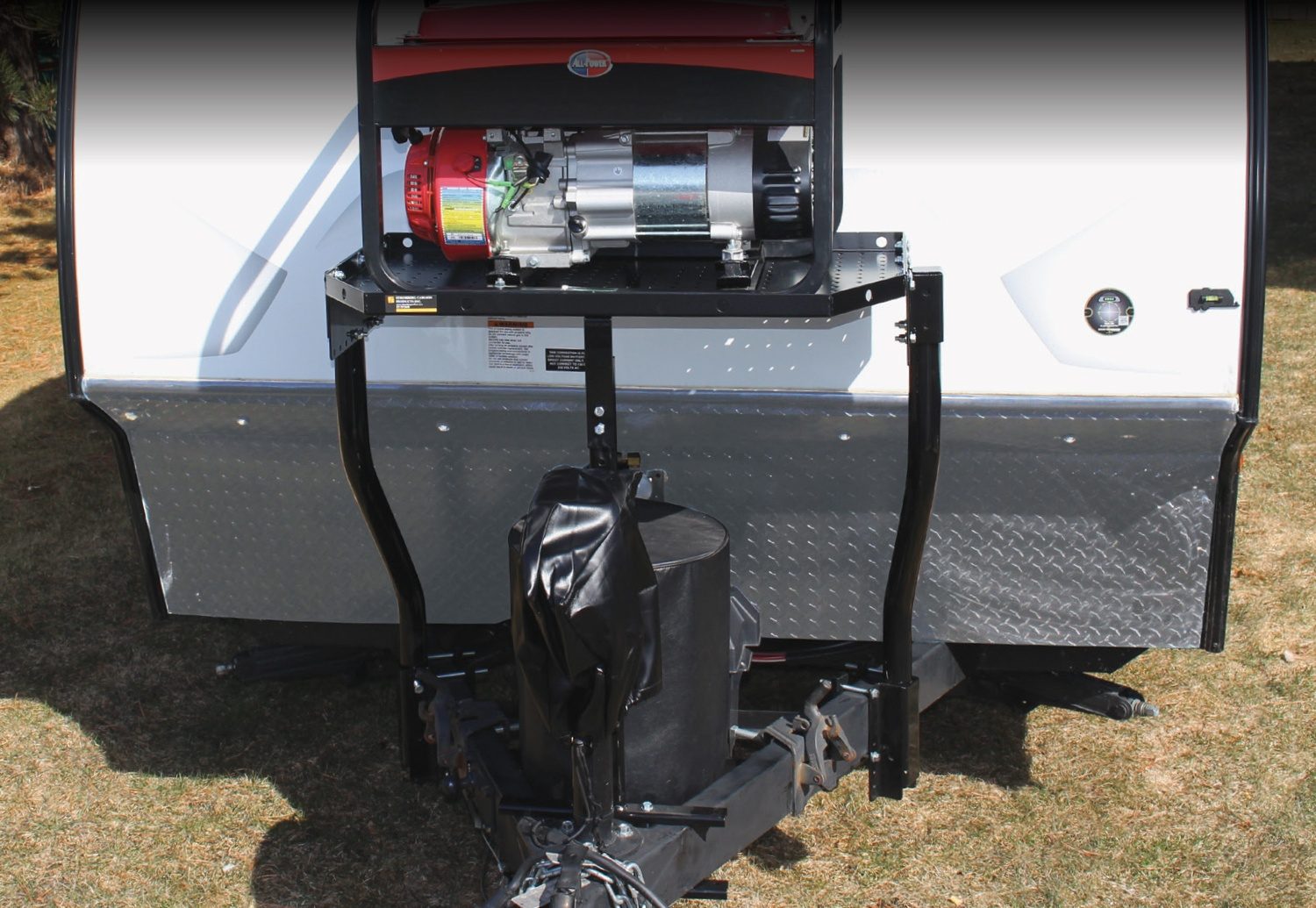
An A-frame tongue tray (e.g. Stromberg Carlson CC-255, 300 lb capacity) for travel trailers.
Bumper warning
Most stock RV bumpers are built for sewer-hose storage, not cargo. Verify the rating or reinforce.
Sway rule
Rear-added weight subtracts from tongue weight. Keep loaded tongue weight at 10-15%.
Theft
Generators get stolen off racks. Plan on a hardened chain, padlock, and locking hitch pin.
Why mounting a generator on your RV deserves real care
Safety first: a generator that falls off at highway speed can kill someone. Verify every rating (mount, bumper, hitch, tongue weight) before towing. Structural work belongs to a qualified weld shop or certified RV technician.
RV generator mounting ideas: 6 options compared
- A-frame tongue tray (e.g., Stromberg Carlson CC-255, 300 lb capacity): best overall for travel trailers. Smoothest ride, crash-protected between trailer and tow vehicle, but eats tongue-weight budget and can block propane access.
- Bumper rack/tray (e.g., Mount-n-Lock GennyGo, up to 400 lb): popular but the riskiest, because the stock bumper is usually the weak link. See the bumper section before choosing this.
- Hitch carrier on a rear receiver (typical 200-500 lb): good for motorhomes and trailers with a proper receiver. Reduces departure angle.
- Frame-tied receiver + carrier: have a weld shop add a 2" receiver to the trailer frame. The right way to mount at the rear.
- Tongue storage box: enclosed, weatherproof, lockable. Some are rated up to about 500 lbs. Check the specific box, because capacities vary a lot. Adds tongue weight and bulk.
- Truck bed (honorable mention): the simplest and safest carry if you have the room; keeps all RV weight ratings untouched.
Travel trailer generator mount: front vs rear
Front (A-frame) rides smoother: the generator sits between trailer and tow vehicle, protected in collisions, and bounces less than anything at the rear. The cost is tongue weight (it adds directly) and possibly blocked propane-tank access.
Rear is popular because it is easy to reach and keeps the tongue light, but it is riskier: rear weight subtracts from tongue weight via the seesaw effect, and a heavy mass far behind the axle acts as a pendulum that amplifies sway. One RV-forum poster estimates that about half the trailer-sway videos online show a generator hanging off the back bumper. The mechanism is tongue-weight loss, not the generator itself. Treat it as one person's observation, not a statistic.
RV generator rack options: bumper racks vs hitch racks
This is the section that matters most, because it is where people get hurt.
RV generator bumper rack: how it attaches
Bumper carriers like the Mount-n-Lock GennyGo clamp to the rear bumper: a 24" x 24" tray on four support arms, rated up to 400 lbs, fitting 4-6" bumpers, with 60+ tiedown points. The carrier's rating is real. The question is what it is clamped to.
What your bumper is actually built for
Most travel-trailer rear bumpers are thin-wall 4" square steel tube designed to store the sewer hose, not to carry cargo. Forum owners report failures under loads far below a generator's weight: one iRV2 member lost an entire bumper carrying two bikes (~80 lbs) after about 120 miles; another reports a bumper tearing at the tube-to-bracket welds after ~30,000 miles with just a spare tire. Some RV makers reportedly warn against bumper loading entirely.
Bumper reinforcement kits
Reinforcement kits exist that tie the bumper into the frame. They are better than raw clamping, but the structurally correct answer is a frame-tied 2" receiver welded to the trailer frame by a qualified weld shop. Documented retrofits carry ~500 lb ratings. Some factory fifth-wheel receivers are rated around 300-350 lbs. Hitch cargo carriers usually rate between 200 and 500 lbs, but the hitch class and the carrier each have their own number, and the lower one wins.
A-frame tongue trays in detail
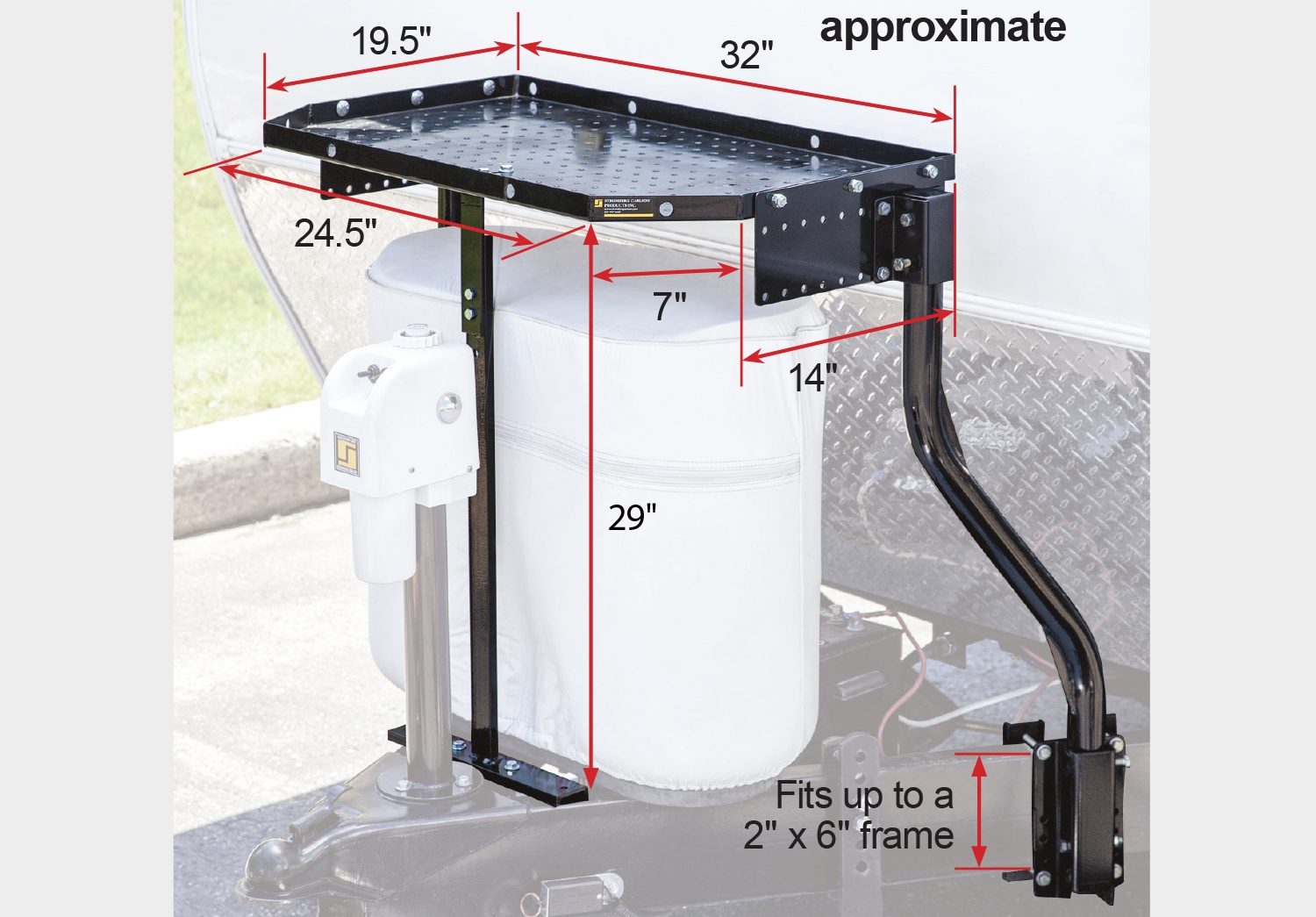
The Stromberg Carlson CC-255 is the reference product: 300 lb load capacity, clamp-on A-frame mounting with no drilling (per the official install sheet, about a 1-hour two-person install), tiedown eyelets, and a US patent. One owner measurement puts the tray itself at ~60-65 lbs, which eats into its own 300 lb rating: plan for ~235 lbs of generator, not 300.
The smoother ride is real: front mounting bounces less than rear. Downsides: it adds to tongue weight (one owner measured ~90 lbs of tongue increase from ~150 lbs of rack plus generator, which tracks with the lever math since the tray sits between the axle and the coupler, not right at it), and it can block propane-tank access or refills on some setups.
Tongue-weight math: the seesaw
Travel trailers need 10-15% of loaded trailer weight on the tongue for stable towing. Weight added behind the axles subtracts from tongue weight by the lever ratio: (axle-to-mount distance) / (axle-to-coupler distance) x added weight. That is the seesaw: the further behind the axle, the bigger the bite.
Worked example: an 80 lb generator on a rear carrier 8 ft behind the axle, with 16 ft from axle to coupler: tongue weight drops by (8/16) x 80 = 40 lbs. On a 5,000 lb trailer targeting 12% (600 lbs of tongue weight), that single change costs you nearly 7% of your tongue weight. Now add the carrier's own weight and it gets worse.
Measure after mounting. The ratio method estimates; a tongue-weight scale (Sherline is the commonly cited brand) confirms. Corrective moves: shift cargo forward, move the spare tire off the rear bumper, or relocate the generator forward.
Installing a generator mount, step by step
- Choose the location using the front-vs-rear and bumper-vs-frame sections above.
- Verify every capacity: mount rating + bumper or hitch rating + tongue-weight budget. All three, not just the mount.
- Dry-fit the empty carrier; check clearances (propane, tail lights, spare tire) and departure angle.
- Fasten: no-drill clamps for A-frame trays, U-bolts or clamps for bumper carriers (with reinforcement), welded receiver for the frame-mounted route.
- Vibration isolation: bolt the generator through heavy rubber anti-vibration blocks, not metal-to-metal.
- Tiedowns: strap the generator at multiple points; ratchet straps alone are not theft protection (see below).
- Ground clearance check: rear carriers reduce departure angle and can drag on steep driveways; angled shanks help. Measure before committing.
- First-trip retorque, then after every washboard road. Vibration loosens everything.
Generator mounting brackets and support arms
Don't need a full tray? You can buy just the pieces: clamp-on support arms to beef up an existing tray, U-bolts for bumper attachment, or a receiver shank for a hitch carrier. Look for steel or aluminum with rust treatment, generous tiedown points, and honest weight ratings. Avoid mystery brackets with no published capacity.
Running it mounted: CO and placement safety
The CDC recommends placing a generator at least 20 feet from the RV with exhaust pointed away from all windows, doors, and vents. A mount cannot meet the 20-foot rule, so if you run the generator on its mount, mitigate:
- Keep all windows, doors, and vents near the mount closed.
- Point the exhaust away from the RV and downwind.
- Consider an exhaust extension (Genturi-style) that routes exhaust above the roofline.
- Keep a working CO detector inside the rig, always.
- Beware negative pressure: running RV exhaust fans while a generator runs nearby can pull exhaust inside.
Never run a generator inside, under, or in an enclosed compartment of the RV. Carbon monoxide is odorless and colorless; headache, dizziness, and nausea are the warning signs, and by then you are already in trouble.
Weather and dust on the mount
- Dust: the rear of an RV is a dust-circulation zone; cover the generator when not in use.
- Rain: if you run it in the rain, use a ventilated canopy: air in, exhaust out. Never seal a running generator inside a box.
Locking and theft prevention
Lock it or lose it. One iRV2 member had a generator stolen off a rear rack while driving in traffic; it was secured by a ratchet strap only. Ratchet straps are tiedowns, not locks.
- Run a hardened chain or cable through the generator's frame and lock it with a quality padlock.
- Use a locking hitch pin or clevis for the carrier itself.
- Cover the generator: out of sight reduces temptation.
- Park strategically: back the mount against a wall or post.
- A GPS tracker is cheap backup for an expensive generator.
Aim for two-person-with-tools removal: anything a thief can defeat in thirty seconds with one hand is decoration.
Frequently asked questions
Can I mount a generator on my RV bumper?
You can, but verify what your bumper is rated for first. Most stock travel-trailer bumpers are thin-wall tube designed for sewer-hose storage, not cargo, and forum owners report bumpers shearing off under loads as light as two bikes. A bumper reinforcement kit or a frame-mounted receiver is the safer answer.
How much weight can an RV bumper hold?
Most stock RV bumpers are not rated for cargo at all; they are built to hold a sewer hose. Products like the Mount-n-Lock GennyGo bumper carrier are rated up to 400 lbs, but that rating is for the carrier, not your bumper. Check your RV's manual, and when in doubt, do not hang cargo on the stock bumper.
What is the best generator holder for an RV?
For travel trailers, an A-frame tongue tray like the Stromberg Carlson CC-255 (300 lb capacity) is the safest overall choice. For rear mounting, a hitch carrier on a frame-tied receiver beats a bumper clamp. For motorhomes, a hitch carrier on the motorhome's receiver is the straightforward answer.
Will a rear generator mount cause trailer sway?
It can, through the tongue-weight seesaw: every pound added behind the axles removes weight from the tongue, and low tongue weight is the classic sway trigger. Keep loaded tongue weight at 10-15% of trailer weight, measure it after mounting, and move cargo forward if it drops.
How do I calculate tongue weight with a generator mounted?
Use the lever-ratio method: rear-added weight reduces tongue weight by roughly (axle-to-mount distance divided by axle-to-coupler distance) times the added weight. Then verify with a tongue-weight scale like a Sherline. Always measure after mounting, because frame geometry varies.
Can I run my generator while it is on the mount?
Yes, with CO mitigations: keep all windows, doors, and vents near the mount closed, point the exhaust away and downwind, and consider an exhaust extension that routes exhaust above the roofline. Never run a generator inside, under, or in an enclosed compartment of the RV. Keep a working CO detector inside the rig.
How do I stop generator vibration on the mount?
Bolt the generator to the mount through heavy rubber anti-vibration blocks rather than rigid metal-to-metal. Retorque all fasteners after the first trip and after any washboard roads. Rigid mounting transmits vibration into the trailer frame and can crack the generator's mounting feet.
How do I lock a generator to my RV?
Run a hardened chain or cable through the generator's frame and lock it with a quality padlock, plus a locking hitch pin or clevis for the carrier itself. One iRV2 member had a generator stolen off a rear rack while driving in traffic, secured only by a ratchet strap.
Do I need to reinforce my RV bumper for a generator?
For a bumper-mounted carrier, reinforcement is strongly advised: bumper reinforcement kits exist for this purpose, and the structurally correct answer is having a weld shop add a frame-tied 2-inch receiver instead. If your RV maker warns against bumper loading, follow the manual.
Can I mount a generator on a fifth wheel or motorhome?
Yes. Fifth wheels can use pin-box area carriers or factory rear receivers (some rated around 300-350 lbs). Motorhomes typically use a hitch carrier on the motorhome's rear receiver. The same rules apply: verify the receiver's rating, mind CO placement, and lock the generator.