How-To Guides
RV Generator Transfer Switch Guide: Automatic vs Manual, 30A vs 50A & Troubleshooting (2026)
Manufacturer specs from Progressive Dynamics, WFCO, Go Power!, Southwire · Troubleshooting from official guides · October 2026
The transfer switch is the traffic cop of your RV's AC power. It decides whether your breaker panel drinks from shore power or your generator, and it makes sure the two never meet. Pick wrong and you either waste money on the wrong amperage or chase phantom electrical faults for years. This guide explains automatic versus manual switches, 30A versus 50A selection, compares the popular models, and consolidates the troubleshooting advice scattered across manuals and forums. For generator sizing itself, see our best generators for campers guide.
Affiliate disclosure: RV Solar Power Guide is reader-supported. When you buy through links on this page, we may earn a commission at no extra cost to you. Our picks come from comparing verified specs and price. We don't accept payment for placement.
What it does
Connects your RV panel to ONE AC source at a time (shore or generator). Prevents dangerous back-feeding.
Automatic vs manual
Automatic senses the generator and switches itself after 20-30s. Manual is cheaper, needs you present.
30A vs 50A
Match your RV's shore service: TT-30 plug = 30A switch, NEMA 14-50 = 50A switch.
Humming?
Usually low voltage or AC coil chatter. DC-coil models eliminate it.
RV generator transfer switch guide
Electrical safety: transfer switch work involves 120V AC that can kill. Before opening any box: unplug shore power, shut the generator off AND its breaker off, and disconnect the batteries. If unsure, consult a certified RV technician or licensed electrician. Every manufacturer manual states this.
What a transfer switch actually does
Your RV has two possible sources of 120V AC power: the campground pedestal (shore power) and your generator. The transfer switch sits between both sources and your main breaker panel, and its one job is to connect the panel to exactly one source at a time.
Why it matters: if generator power ever back-fed into the shore pedestal, it could energize the campground grid and injure a line worker. The switch prevents this with a break-before-make mechanism: the connection to the old source fully breaks before the new source engages. Shore power is the default; the generator input takes command only when it is energized and stable, per the Parallax ATS manual and every major brand's documentation.
Automatic vs manual: how they differ
Automatic (ATS): senses generator power, waits 20 to 30 seconds for voltage and frequency to stabilize, then transfers with an audible click. Generator-dominant: when both sources are live, the ATS picks the generator after the delay. Shore power passes through without energizing the relays. Best for onboard generators and anyone who wants hands-off operation.
Manual: a lever or rotary switch you flip yourself. Cheaper, simpler, no delay module to fail. Best for portable generators and tight budgets, but you must be present to switch, and forgetting means no power. Many older RVs use the simplest manual method of all: unplugging the shore cord and plugging it into the generator's receptacle.
30A vs 50A: which one you need
30A RV service (TT-30): one 120V hot leg, neutral, ground. Maximum 3,600W. The transfer switch switches one hot plus neutral.
50A RV service (NEMA 14-50): two 120V hot legs (L1 and L2), neutral, ground. Up to 12,000W. The transfer switch switches L1, L2, and neutral. Note: most RVs have no 240V appliances; the two legs simply feed separate halves of the 120V breaker panel.
The selection rule is simple: match the ATS to your RV's shore service. Check your shore cord plug: TT-30 means 30A, NEMA 14-50 means 50A. A 30A transfer switch can never serve 50A service. A 50A switch on a 30A RV is oversized but electrically compatible if wired correctly. When you adapt a 50A RV to a 30A pedestal with a dogbone adapter, the single 30A leg jumpers to both L1 and L2 in phase, and the energy management system limits you to 30A total.
Popular transfer switches compared
Specs below are from manufacturer-published documentation. No prices, no affiliate links: this is a selection guide, not a store.
- Progressive Dynamics PD5110010V (30A): 120VAC, pigtail wire connections (screw-terminal variant PD5110610V available). Quick-change circuit board, generator-voltage time delay, 1-year warranty. Per PD's manual.
- Progressive Dynamics PD52V (50A): 240VAC, 50A with 70A neutral rating, metal enclosure, mechanical plus electrical safety interlocks. A common owner replacement for failed IOTA ITS-50R units, per forum reports.
- Progressive Dynamics PD52DCS (50A + surge): adds open-neutral, reverse-polarity, and under/over voltage protection plus multimode surge protection rated 3,300 joules. DC coil eliminates buzzing; LED indicators for source and surge status.
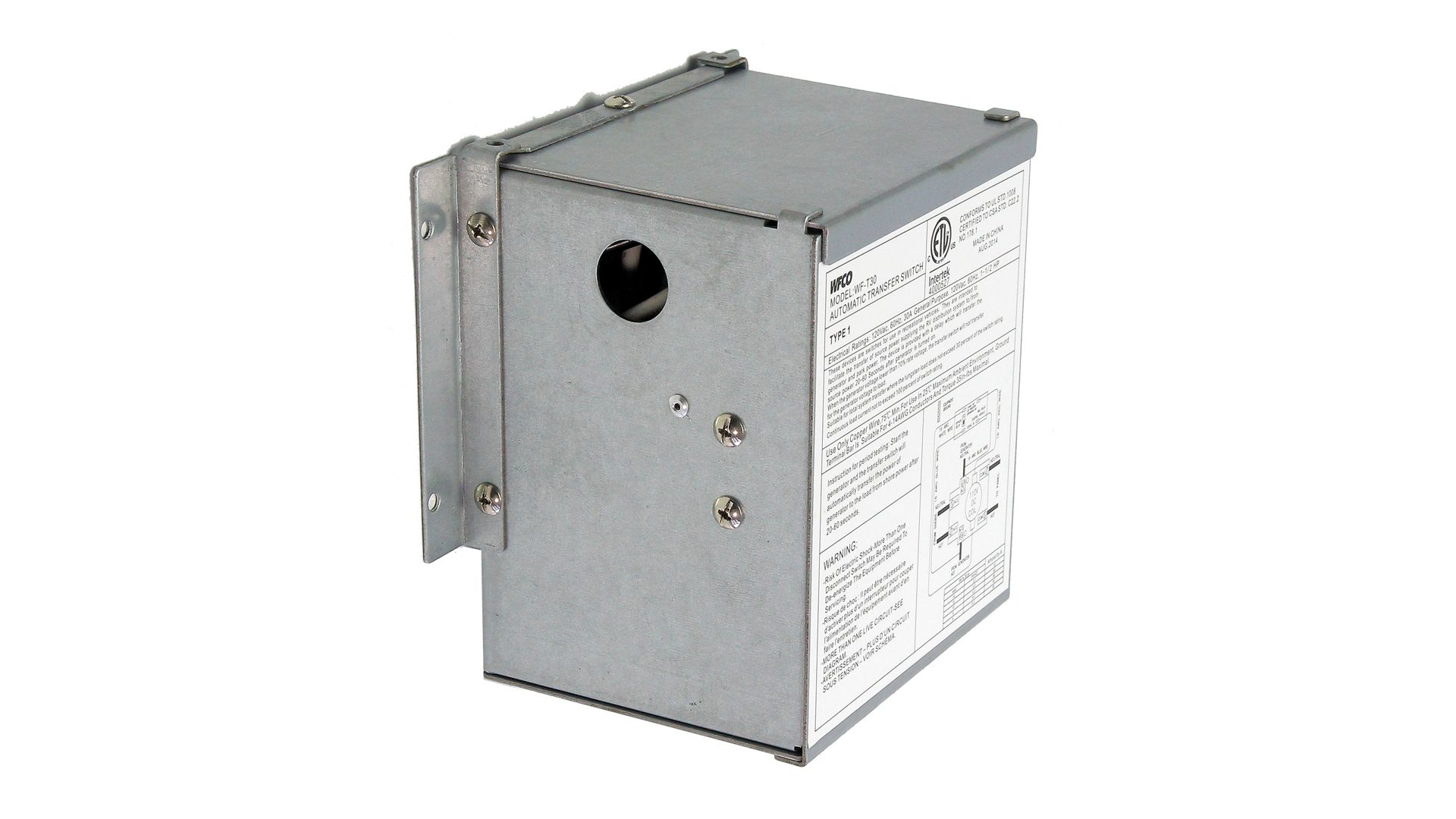
- WFCO T-30 (30A) / T-57 (50A): DC coil prevents AC chatter and dropout in low-voltage conditions. Break-before-make. 30-second nominal delay. UL/cUL listed, 2-year warranty. The T-30 mounts to the back of WFCO 8900 series power centers.
- Go Power! GP-TS-30 / GP-TS-50: designed for three-source RV/marine systems with priority generator, then shore, then inverter. 20 to 30 second delay with audible click. Timer-delay bypass switch for emergencies. Diagnostic LED identifies a failed delay module. Published 4-step operational test in the manual.
- Southwire Surge Guard 41300 (30A) / 40100 (50A): basic ATS units, UL 1008 listed, mechanical interlocking contactors. The 40100 transfers to generator in 30 seconds and back to shore in 3 to 4 seconds. Note: the 40100 provides no surge protection despite the brand name.
- Xantrex PROwatt SW inline (15A): compact inline transfer switch for PROwatt SW inverters. Transfer time under 120ms utility-to-inverter, under 20ms inverter-to-utility. Xantrex Freedom X inverter/chargers include a built-in 30A ATS.
Transfer switch + surge protection combos
Two units combine switching with full surge and wiring-fault protection:
- Progressive Dynamics PD52DCS: 3,300 joules of surge protection, open-neutral and reverse-polarity protection, under/over voltage cutoff, DC coil for silent operation.
- Southwire Surge Guard 40350-RVC: 3,350 joules / 130,000A max spike, 65A contactor rating, over/under voltage, open neutral, open ground, miswired-pedestal indication, RV-C communication, optional remote display. Error codes include NO GROUND, HIGH/LOW VOLTAGE (will not engage outside 102-132V), HIGH/LOW FREQUENCY (requires 55-70 Hz), L1/L2 OPEN, and REVERSE POLARITY. After a fault clears, about a 2.5-minute delay precedes re-engagement.
Who benefits: full-timers and anyone camping on sketchy older campground pedestals. For everyone else, a basic ATS plus a separate portable surge protector at the pedestal covers the same risks.
Inverter + generator + shore: three-source setups
Many RVs run three AC sources: shore, generator, and inverter. Go Power!'s transfer switches handle this with a fixed priority: generator first, then shore power, then inverter. The inverter feeds only its designated circuits when neither shore nor generator is present.
Two wiring traps to avoid:
- The converter loop: the converter/charger must NOT be powered from an inverter-fed circuit. If it is, the inverter drains the batteries to run the converter that is trying to charge them: a loop that kills the bank. Re-route the converter input to the shore-power side of the switch.
- Neutral-ground bonding: on shore power, neutral and ground stay isolated (the bond is at the park pedestal). On generator power, they bond at the generator. Inverter transfer relays manage this automatically; miswired bonds cause nuisance tripping and failed surge-protector checks.
For inverter selection itself, see our RV inverter guide.
Installation overview
This is an overview, not a step-by-step wiring tutorial. If you are not comfortable with 120V AC wiring, hire a certified RV technician.
- Kill every source: unplug shore power, generator off and its breaker off, batteries disconnected. Verify dead with a meter.
- Mount near the shore cord entry or behind the breaker panel, in a dry ventilated spot. The box is roughly shoebox sized (the PD52V is about 10 by 7 by 4.5 inches, 7 lbs).
- Route three cable sets: shore cord to the shore input, generator feed to the generator input, ATS output to the main breaker panel. Keep generator and shore wiring separated per the manual.
- Torque every terminal to spec. Loose high-current terminals arc, overheat, and start fires. This is the single most skipped step in DIY installs.
- Run the operational test (adapted from Go Power!'s manual): plug in shore, confirm loads normal, unplug. Start the generator, wait for the delay click, confirm loads normal. Shut down the generator, confirm disengage. Then plug in shore AND start the generator: after the delay it should transfer from shore to generator automatically.
For wire sizing on these runs, see our RV wiring diagram guide.
Troubleshooting
No transfer to generator: wait the full 30-second delay first; many "faults" are impatience. Then check the generator's own breaker, verify generator voltage above about 90VAC at the switch input (per the Surge Guard 40100 guide, the contactor will not pull in below that), confirm frequency is within 55 to 70 Hz, and torque-check terminals with all power off. On Go Power units, the diagnostic LED tells you if the time-delay module itself failed.
Humming or chattering: low input voltage or AC coil chatter. DC-coil models (WFCO, PD52DCS) are designed to eliminate it. Also check for loose terminal connections, with all power off.
Stuck contactor / power in, nothing out: the switch is faulty. RV transfer switches are replaced as a whole box, not repaired in the field, per RV technician guidance and manufacturer manuals.
Panel reads 30A on a 50A RV: suspect a lost leg at the transfer switch. Check L1/L2 voltage at the switch with all power off first, per owner-troubleshooting reports.
Surge Guard error codes (40350): NO GROUND, HIGH/LOW VOLTAGE, HIGH/LOW FREQUENCY, L1/L2 OPEN, REVERSE POLARITY, CHECK SURGE (blown surge fuse: transfer still works, protection is lost). After any fault clears, expect about 2.5 minutes before re-engagement.
Maintenance
- Annual torque check on all terminals, with every power source off. Vibration loosens lugs over time.
- Inspect for heat: discoloration or a burnt smell around the box means a failing connection. Address immediately.
- Exercise the generator monthly under load so the ATS cycles through its transfer sequence instead of sitting idle for a season.
- Keep it dry and ventilated. These boxes are not waterproof; a wet bay shortens contactor life.
Frequently asked questions
What does an RV transfer switch do?
An RV transfer switch connects your RV's electrical panel to only one 120V AC source at a time: shore power or generator. It prevents back-feeding generator power into the shore pedestal, which is dangerous. Automatic switches sense stable generator power and transfer after a 20 to 30 second warm-up delay, using a break-before-make mechanism.
Do I need a transfer switch for a portable generator?
Not if you run extension cords from the generator to your appliances. You need a transfer switch only when hardwiring the generator into the RV's breaker panel. For portable generators, a manual transfer switch is the budget-friendly answer; automatic switches suit onboard generators.
Automatic vs manual transfer switch: which is better for an RV?
Automatic is better for onboard generators and convenience: it senses the generator, waits 20 to 30 seconds for stable power, and switches by itself. Manual is better for portable generators and tight budgets: cheaper, simpler, but you must be present to flip it. Many older RVs also use the plug-the-shore-cord-into-the-generator method, which is a manual transfer of sorts.
What size transfer switch do I need: 30 amp or 50 amp?
Match the transfer switch to your RV's shore service. A 30A RV (TT-30 plug, single 120V hot, 3,600W max) needs a 30A switch. A 50A RV (NEMA 14-50 plug, two 120V hots, 12,000W max) needs a 50A switch. A 30A transfer switch can never serve 50A service.
Why does my RV take 30 seconds to switch to generator power?
That is the normal warm-up delay built into every major brand's automatic transfer switch. The delay (20 to 30 seconds depending on brand) lets the generator's voltage and frequency stabilize before the switch transfers the load. You will usually hear an audible click when it engages.
Why is my transfer switch humming or buzzing?
Humming is usually AC coil chatter from low input voltage or a loose terminal connection. Transfer switches with DC coils (such as WFCO models and the Progressive Dynamics PD52DCS) are designed to eliminate this buzzing. Check all terminal connections with all power sources off, and verify the generator is producing proper voltage.
Why won't my RV switch to generator power?
Wait the full 30-second delay first. Then check: the generator's own breaker is not tripped, generator voltage at the switch input is above about 90VAC, frequency is within 55 to 70 Hz, and all terminals are torqued with power off. A failed time-delay module (Go Power units show this via a diagnostic LED) or a stuck contactor means the unit needs replacement.
Can a transfer switch go bad? How do I know?
Yes. The classic symptom: power reaches the switch input but nothing comes out. Other signs are a stuck contactor, burnt smell, or heat discoloration on the box. RV transfer switches are generally replaced as a whole unit rather than repaired in the field.
Can I use my inverter with a transfer switch?
Yes. Three-source setups use a priority order, typically generator first, then shore power, then inverter (per Go Power!'s manual). Some inverter/chargers like the Xantrex Freedom X have a built-in 30A transfer switch. The critical wiring rule: never let the inverter power the converter/charger, or the inverter will drain the batteries trying to charge them.
Should I get a transfer switch with built-in surge protection?
It depends on how you camp. Combo units like the Progressive Dynamics PD52DCS (3,300 joules) and Southwire Surge Guard 40350 (3,350 joules) protect against open neutrals, reverse polarity, and voltage extremes on top of switching. Full-timers on sketchy campground pedestals benefit most. Otherwise a basic transfer switch plus a separate surge protector works fine.