Power Protection
RV Electrical Management System vs Surge Protector: Which One Your Rig Needs (2026)
Progressive Industries, Hughes and Southwire specs verified from manuals · Error-code-level detail · October 2026
At almost every campground you will see a device hanging from the power pedestal, and almost everyone calls it a surge protector. Half of them are not surge protectors at all. They are electrical management systems, or EMS units, and the difference is not marketing fluff. A surge protector absorbs one thing: brief voltage spikes. An EMS stands guard over everything else that campground power can do to your rig: brownouts that cook air conditioners, open neutrals that swing one leg toward 240 volts, miswired pedestals, bad frequency. This guide explains what each device actually does, the specs that separate them, and when the EMS upgrade is worth your money. If you are sizing generator power instead, our generator sizing guide covers that side.
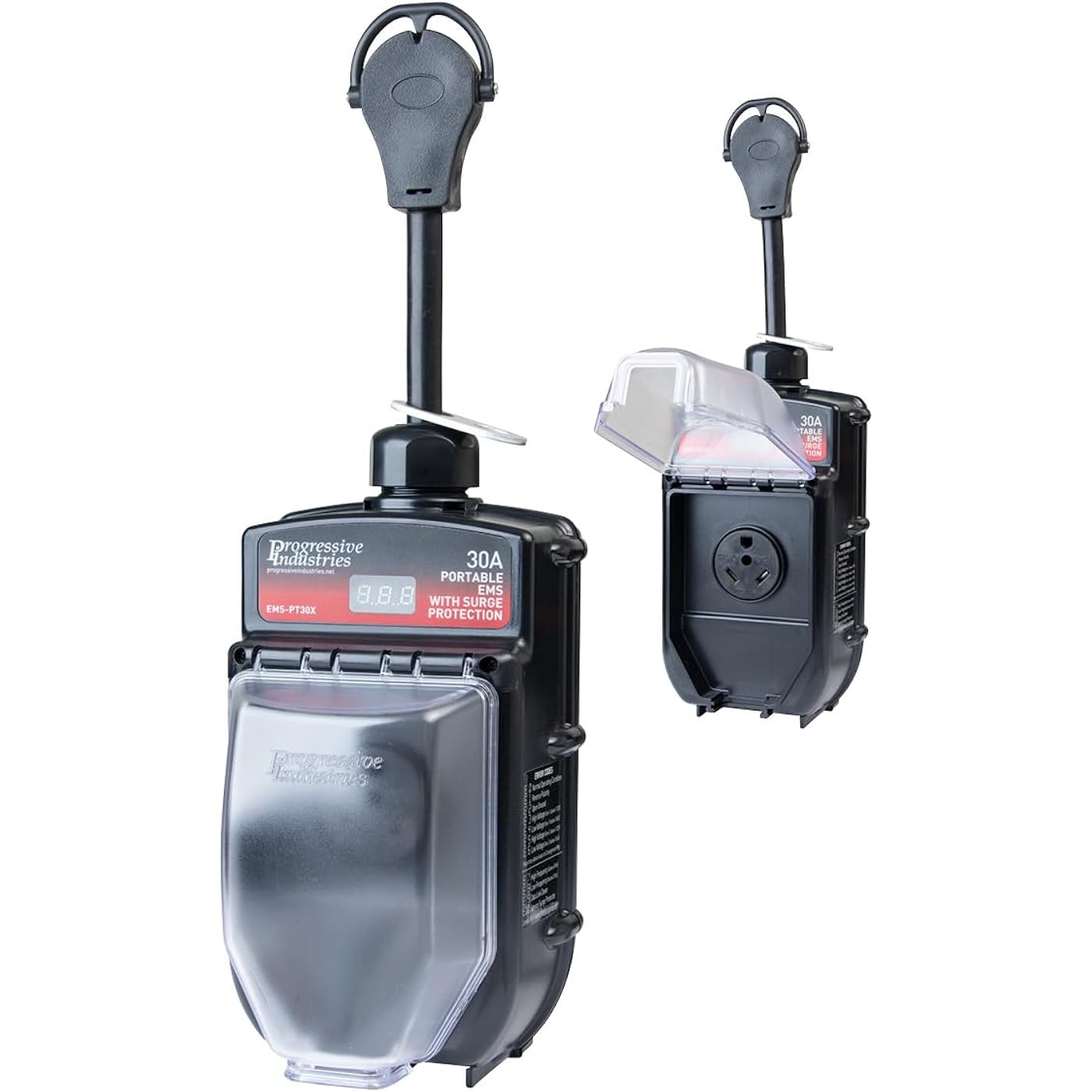
Affiliate disclosure: RV Solar Power Guide is reader-supported. As an Amazon Associate, we earn from qualifying purchases: when you buy through links on this page, we may earn a commission at no extra cost to you. Our picks come from comparing verified specs and price. We don't accept payment for placement.
What an EMS is
A device that checks pedestal power before it reaches your RV and keeps watching it: it cuts power on bad voltage, bad wiring, or bad frequency, then reconnects automatically.
Core difference
A surge protector only absorbs brief spikes. An EMS also disconnects sustained high/low voltage, open neutral, open ground, reverse polarity, and frequency faults.
The #1 campground fault
Low voltage, below about 104V. It overheats air conditioner motors, and a basic surge protector passes it straight through.
Buying rule
Match the EMS to your shore inlet: 30A rig takes a 30A EMS, 50A rig takes a 50A EMS. Portable hangs on the pedestal; hardwired lives inside the rig.
RV electrical management system vs surge protector guide
Safety: an EMS reports what it finds at the pedestal, but it is not a license to rewire anything. Never open a campground pedestal, never bypass a fault to get power, and never substitute an EMS reading for an electrician's diagnosis. If a pedestal fails the EMS check, report it to the campground and move to another site. If unsure, consult a certified RV technician.
What an RV electrical management system actually does
An EMS is a microprocessor-controlled gatekeeper that sits between the campground pedestal and your RV's shore power cord, or permanently wired behind the shore inlet. Every EMS does the same three things: check, decide, and disconnect.
Check. When you plug in, the unit first analyzes the pedestal wiring before passing a single volt to your rig. It looks for an open ground (the safety wire is missing), an open neutral (the return path is broken), and reverse polarity (hot and neutral swapped). If any of those checks fail, the relay stays open and the display tells you why. Progressive Industries units hold power off through a 136-second countdown during this test, and reviewers consistently report about a two-minute wait before power flows on a first plug-in.
Decide. Once power passes the wiring test, the EMS keeps measuring. The numbers from the actual manuals: a Progressive Industries EMS cuts power if voltage stays below 104V for more than 6 seconds, or above 132V (with faster trips at higher voltages: 1 second above 140V, 60 milliseconds above 156V). The Hughes Power Watchdog disconnects below 104V or above 132V. The Southwire Surge Guard uses a slightly lower floor: 102V. Frequency is watched too, with Progressive's manual listing its high and low frequency error bands around roughly 67 and 53 Hz. Nominal is 120V and 60 Hz, and the 104 to 132V window is the band all three brands agree a rig can tolerate.
Disconnect. On a fault, an internal relay opens and your rig goes dark, protected. The EMS keeps watching the pedestal the whole time, and once conditions return to the safe band it counts down its compressor-protecting time delay and restores power on its own. Most units also carry a joule-rated surge section, 1,790 joules on the Progressive 30A portable, 2,450 on the Hughes, 2,450 on the Southwire 30A portable, that absorbs brief spikes just like a standalone surge protector. Everything a surge protector does, an EMS does, plus the monitoring and disconnection.
What a basic surge protector does (and where it stops)
A basic surge protector is a simpler animal. Inside it are MOVs, metal-oxide varistors, which act like pressure relief valves: when voltage spikes above a threshold for a fraction of a second, the MOVs conduct the excess to ground and clamp the spike before it reaches your rig. That reaction happens in nanoseconds, which is genuinely the fastest spike protection available, and it is why the device sacrifices itself on a big hit like a lightning strike.
Here is the honest list of what it cannot do. A basic surge protector has no continuous voltage monitoring, so a brownout that sags to 100V all afternoon passes straight through while your air conditioner motor slowly overheats. It does not disconnect power on its own: after absorbing its rated joules, the MOVs are spent and the unit either quietly offers no more protection or must be replaced. Most basic units do not check for reverse polarity, open neutral, or frequency, and they cannot reconnect you automatically because they never disconnected you in the first place. Some mid-tier units add wiring-fault indicator lights, but an indicator that stays lit while power keeps flowing is information, not protection.
That does not make surge protectors useless. They are cheap, passive, and excellent at the one thing they do. The mistake is believing they cover the faults RVers actually meet at campgrounds, which are overwhelmingly slow, sustained power quality problems, not dramatic lightning strikes.
EMS vs surge protector: side by side
The table below is the real comparison, built from the three manufacturers' manuals rather than marketing copy.
| Protection feature | Basic surge protector | Full EMS |
|---|---|---|
| Brief voltage spikes | Yes (MOV clamping, fastest response) | Yes (joule-rated surge section included) |
| Sustained high voltage (above ~132V) | No | Yes, automatic disconnect |
| Low voltage / brownout (below ~104V) | No | Yes, automatic disconnect |
| Open neutral | No (some units light an indicator) | Yes, refuses to connect |
| Open ground | No (some units light an indicator) | Yes, refuses to connect |
| Reverse polarity / miswired pedestal | Indicator only on better models | Yes, refuses to connect |
| Frequency outside band | No | Yes, automatic disconnect |
| Automatic reconnect after fault clears | Not applicable | Yes, after a time delay |
| Compressor restart delay | No | Yes, 90 to 136 seconds by brand |
| Live voltage/amp display | Rare | Standard (display, Bluetooth, or app) |
| Typical cost tier | One figure range | Roughly 2 to 4 times the surge-only tier |
The pattern is simple: a surge protector is a shock absorber, and an EMS is a shock absorber with a full-time inspector, a circuit breaker, and a memory. Every fault an EMS catches beyond spikes is a fault a surge protector waves through.
The two campground faults that matter most
Competitor articles list every possible fault, which is honest but unhelpful. In practice, two faults do almost all the damage RVers report, and both are invisible to a basic surge protector.
Low voltage. On a hot Saturday afternoon, every rig in the loop runs two air conditioners at once, the campground transformer sags, and your pedestal drops to 100V. Your A/C motor still tries to do the same work, so it draws more current at the lower voltage, heats up, and shortens its life, or dies outright. Nothing dramatic happens. No sparks, no tripped breaker. Just a motor running hot for hours. This is the most common real-world campground power problem, and it is exactly what the EMS low-voltage cutoff, 104V on Progressive and Hughes, 102V on Southwire, exists to stop.
Open neutral. This one is the killer on 50A service. A 50A pedestal delivers two 120V hot legs that share a single neutral, and the neutral balances them so each leg sees roughly 120V. When that neutral breaks, or its connection corrodes, the balance is gone: one leg can swing toward 240V while the other collapses. The high side fries everything 120V in seconds. On 30A service the signature fault is different but just as nasty: a house electrician who has never wired an RV outlet connects your 30A receptacle as 240V, like a dryer, and your rig's entire 120V system sees double voltage at plug-in. Progressive's manual lists accidental 220V as one of its disconnect conditions for exactly this reason. No surge protector stops either scenario; both are instant EMS disconnects.
Everything else the EMS watches, frequency drift, reverse polarity, missing ground, is real but rarer. Buy the EMS for low voltage and open neutral, and consider the rest a bonus.
How an EMS guards your rig
Understanding the sequence helps you read the display instead of fighting it.
- The plug-in test. Plug the EMS into the pedestal first, alone, then switch the pedestal breaker on. The unit spends its startup delay, about 136 seconds on a Progressive, 90 on a Hughes, 10 on a Southwire portable, analyzing the wiring and voltage. Only then does it close its relay. This is why experienced RVers plug the EMS in by itself first: if the pedestal fails, you find out before your rig is ever connected.
- Continuous monitoring. Once power flows, the microprocessor samples voltage, and on 50A units each leg separately, plus frequency. It reacts to spikes in a fraction of a second and to sustained out-of-band voltage within the seconds specified in the manual. The display cycles through volts, amps, and frequency on most units, so you can see a sag developing in real time.
- The disconnect. On a fault, the relay opens and your rig goes dark. This is the moment new EMS owners panic about, and it is the device doing its job. The error code tells you which fault fired: low voltage, open neutral, and the rest.
- The wait and the reconnect. The EMS keeps monitoring while power is cut. When voltage returns to the safe band and stays there, it starts its time delay, then reconnects. The delay is deliberate compressor protection. If you are doing electrical work during an outage, unplug the RV first: the power can come back on its own.
One practical note: the surge-absorption side of an EMS is consumable, even though the monitoring side is not. Absorbing spikes uses up the MOV capacity a little at a time. A nearby lightning strike can exhaust it in one event, and the unit will tell you with a surge-failure code. The Hughes Power Watchdog makes that a field repair with its replaceable surge module; on other units it means a warranty claim or replacement.
Three EMS lines RVers actually buy
The market is dominated by three brands, and their manuals are specific enough to compare honestly. This is not a ranking; each has a real strength, and the right pick depends on what you value. Specs below are from the manufacturers' own manuals.
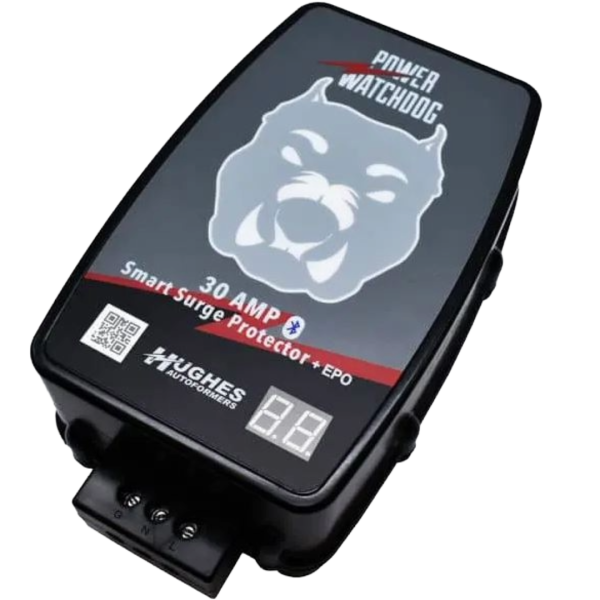
| Spec (30A portable) | Progressive Industries EMS-PT30X | Hughes Power Watchdog PWD30EPO | Southwire Surge Guard 34930 |
|---|---|---|---|
| Surge absorption | 1,790 joules | 2,450 joules | 2,450 joules |
| Low-voltage cutoff | Below 104V (6+ seconds) | Below 104V | Below 102V (8+ seconds) |
| High-voltage cutoff | Above 132V (stepped: faster at higher volts) | Above 132V | Above 132V (8+ seconds) |
| Reconnect delay | 136 seconds | 90 seconds | 128 seconds |
| Wiring-fault checks | Open ground, open neutral, reverse polarity | Open ground, open neutral, reverse polarity, voltage on ground | Open ground, open neutral, reverse polarity, miswired pedestal, overheating plug |
| Display / monitoring | On-unit scrolling display | Bluetooth app + on-unit codes (Gen II adds WiFi) | LCD display (English) |
| Surge module replaceable | No (lifetime warranty instead) | Yes, field-replaceable | Not documented |
| Standout trait | Lifetime warranty, granular stepped overvoltage trips | Replaceable surge module, phone monitoring, auto-restart | Lowest voltage floor (102V), plug-overheat sensing, lock ring |
Read the standout row as a buying hint. Progressive's lifetime warranty and its stepped overvoltage response, tripping in 60 milliseconds above 156V, suit owners who want the most aggressive hardware protection and never think about the unit again. Hughes suits owners who want to watch power from their phone and replace the surge module instead of the whole unit after a big event. Southwire suits owners who want the lowest trip floor and the only plug-overheat sensing of the three, plus an anti-theft lock ring built into the cord.
All three come in 50A versions that monitor both hot legs independently, and all three offer hardwired versions. Our dedicated surge protector buying guide compares the full portable and hardwired lineup in detail when it publishes.
Portable or hardwired: which install suits you
The protection is identical either way. The install changes everything else.
Portable hangs on the pedestal between the outlet and your shore cord. Advantages: you see the display at plug-in, where you are standing anyway; you can move it to your next rig; installation is zero. Disadvantages: it lives outside in sun, rain, and dust; it can be stolen, which is why every brand offers a locking bracket or cable; and it is one more thing to pack up every travel day. Portables suit renters, owners who might upgrade rigs, and anyone who wants the display visible at the pedestal.
Hardwired mounts inside the RV, usually right behind the shore power inlet, wired in series with the incoming feed. Advantages: it is protected from weather and theft, and it is always in the circuit, so you cannot forget it. Disadvantages: installation means opening the AC wiring, which is a technician job for most owners; you need the optional remote display panel mounted inside to see status; and it stays with the rig when you sell. Hardwired suits full-timers and anyone who never wants to think about power protection again after install day.
Either way, size the EMS to the rig's shore inlet. One more point that trips people up: a 50A EMS on a 30A pedestal via adapter still protects fully, because the monitoring is about voltage and wiring, not about the pedestal's current limit. The reverse, a 30A EMS feeding a 50A rig, is never acceptable.
Who should buy an EMS (and who can skip it)
Buy one if: you camp at older campgrounds or state parks with tired electrical infrastructure; you run air conditioning through summer afternoons when the whole loop sags; you own a 50A rig, where an open neutral can put 240V on your 120V circuits; you have ever lost an appliance to bad pedestal power; or your rig's electronics (inverter, control boards, residential fridge) would cost more to replace than the EMS costs. One destroyed air conditioner pays for the EMS several times over.
A basic surge protector may be enough if: you only plug into your own home outlet that you had wired by an electrician who knows RV receptacles; you are a fair-weather weekend camper who never runs the A/C; or your rig is an older, simple unit with minimal electronics. Even then, the surge protector is the floor, not the ceiling.
Nobody is protected by nothing. Plugging a modern rig straight into an unknown pedestal is the one choice every source in this guide agrees is a mistake. Campground power is shared, aging, and maintained to wildly varying standards; a thirty-second plug-in test with an EMS is the cheapest insurance in the hobby.
Using an EMS at the pedestal: the right order
The sequence that avoids nuisance trips and gives you the earliest warning:
- Breaker off, EMS on first. Make sure the pedestal breaker is off, plug the EMS into the pedestal alone, then switch the breaker on. Let it run its full startup analysis before your rig is involved.
- Read the display. You want a clean bill: voltage near 120V, no error codes. If it shows a fault, believe it. Turn the breaker off, try another pedestal, or talk to the campground host. Do not plug around it.
- Breaker off again, plug in the rig. Switch the pedestal breaker off, connect your shore cord to the EMS, then switch the breaker back on. The EMS will run its delay and then close the relay.
- Lock it. If you are leaving a portable unit on the pedestal, cable-lock it. Theft of portable protectors is common enough that every brand ships a locking point.
- Watch the first hot afternoon. Voltage is highest in the morning and lowest when every A/C in the park is running. If your EMS cuts out at 3 p.m. on a 100 degree day, that is low voltage doing exactly what you paid the unit to catch. Shed loads or wait it out.
One common confusion: pairing an EMS with a portable generator. Most portable generators have a floating neutral, which the EMS reads as an open ground and refuses to accept. The fix is a neutral-ground bonding plug on the generator, not a different EMS. Our generator transfer switch guide explains how shore and generator power meet inside your rig.
Mistakes that leave you unprotected
- Calling it a surge protector and treating it like one. The most expensive mistake is buying a basic surge protector, believing it covers low voltage and wiring faults, and camping confidently through brownouts.
- Plugging the rig in first, EMS second. If you connect the shore cord and then hang the protector downstream of nothing, the rig saw the unprotected pedestal first. EMS first, rig second, every time.
- Overriding a fault to get power. Some units have a bypass mode. Bypassing an open-neutral or reverse-polarity fault to run the air conditioner is how rigs get fried. A fault the EMS found is a fault that is really there.
- Wrong amperage. A 30A EMS on a 50A rig is undersized hardware in the main feed. Match the device to the inlet, not to the pedestal you happen to be on.
- Ignoring the surge-failure code. The monitoring side of an EMS can outlive its surge section by years. When the display says the surge protection is spent, the voltage monitoring still works, but you no longer have spike protection. Service or replace the unit.
- Assuming the generator is covered the same way. The EMS watches whatever AC source feeds it, but a floating-neutral portable generator will trip the open-ground check until you add a bonding plug. Test the combination at home, not at a dark campsite.
- Leaving a portable unlocked at a busy park. It is a several-hundred-dollar device hanging on a post in public. Use the locking bracket or a cable.
Power protection is the least glamorous upgrade on an RV and one of the highest value. A surge protector covers the lightning strike you will probably never see. An EMS covers the sagging, miswired, corroded pedestal you will absolutely meet, probably this season. That is the whole argument, and it is why so many full-timers treat an EMS as standard equipment rather than an accessory.
Frequently asked questions
What does an RV electrical management system actually do?
An RV electrical management system (EMS) is a device you plug into the campground pedestal, or wire in permanently behind your shore-power inlet, that continuously monitors the incoming AC power. Before it lets any power reach your RV, it checks the wiring for open ground, open neutral, and reverse polarity. Then it keeps watching voltage and frequency every second: if voltage sags below about 104V or spikes above about 132V, or the frequency drifts off, it disconnects your rig automatically and reconnects after a time delay once power is safe again. It also absorbs short voltage spikes, so it covers the surge-protector job too.
Is an EMS better than a surge protector for an RV?
For protection scope, yes. A basic surge protector handles one job: absorbing brief voltage spikes. It cannot stop sustained high voltage, low voltage (brownouts), an open neutral, reverse polarity, or bad frequency, and it usually cannot disconnect your rig on its own. An EMS handles all of those, plus the spike absorption, with automatic disconnect and reconnect. The tradeoff is cost: an EMS typically runs several hundred dollars, while a basic surge protector costs a fraction of that.
Will a basic surge protector protect my RV from low voltage?
No. A basic surge protector is built to clamp brief spikes, not to watch voltage levels continuously. Low voltage is a slow killer: at 100V, an air conditioner motor draws more current to do the same work, overheats, and can fail prematurely. The surge protector passes that low voltage straight through to your rig. Only an EMS, or another device with voltage monitoring, will disconnect power when voltage drops below its cutoff (typically 102 to 104V).
What happens when an EMS detects a problem with shore power?
It opens a relay and stops power from reaching your RV immediately, then shows an error code or message identifying the fault, such as low voltage, open neutral, or reverse polarity. It keeps monitoring the pedestal the whole time power is cut. Once the fault clears and voltage stays in the safe band, the EMS starts a countdown timer (136 seconds on Progressive Industries units, 90 seconds on the Hughes Power Watchdog, 128 seconds on the Southwire Surge Guard) before restoring power. That delay protects your air conditioner compressor from restarting against high head pressure.
Why does my EMS take two minutes to restore power?
That wait is compressor protection, not slowness. When an air conditioner loses power abruptly, refrigerant pressure stays high inside the compressor for a minute or two. Restarting against that pressure stresses the compressor and can trip it. EMS makers build in a fixed time delay before reconnecting, 136 seconds on Progressive Industries units, 90 seconds on the Hughes Power Watchdog, and 128 seconds on the Southwire Surge Guard, so the compressor has time to equalize. The same delay runs at initial plug-in.
What is an open neutral, and why is it so dangerous in an RV?
In a 50A RV service, two 120V hot legs share one neutral wire, and the neutral balances them so each leg sees about 120V. If that neutral breaks (an open neutral), the two legs unbalance and one side can swing toward 240V while the other drops toward zero. The result is fried 120V appliances on the high side. Even before full failure, a loose neutral causes wild voltage swings. An EMS detects the lost neutral and refuses to connect, which is why RVers consider open-neutral protection one of the most valuable EMS features.
Should I buy a 30A or 50A EMS?
Match the EMS to your RV's shore power inlet, not the pedestal. A 30A rig needs a 30A EMS; a 50A rig needs a 50A EMS, because the 50A unit monitors both hot legs independently. Never run a 50A rig on a 30A EMS: the device and the plug are not rated for the load the rig can pull. If you sometimes plug a 50A rig into a 30A pedestal with an adapter, keep the 50A EMS and let the rig's main breaker do the current limiting.
Portable or hardwired EMS: which is better?
They protect identically; the choice is convenience. A portable EMS hangs on the pedestal: you see its display right at plug-in, you can move it to your next rig, but it can be stolen and it bakes in the sun and rain. A hardwired EMS lives inside the RV behind the power inlet: it is protected from weather and theft and always in the circuit, but you need its remote display panel inside to see status, and it stays with the rig if you sell. Full-timers and anyone who hates one more thing to set up usually go hardwired; renters and multi-rig owners go portable.
Does an EMS work with a portable generator?
Usually, but expect it to complain. Most portable generators, including inverter generators, have a floating neutral, meaning the neutral is not bonded to ground inside the generator. An EMS reads that as an open ground and refuses to connect. The standard fix is a neutral-ground bonding plug, a small adapter that connects neutral and ground on the generator side, which the EMS then sees as a properly grounded source. Without it, you will get an error code instead of power. Check your EMS manual and your generator manual before assuming compatibility.
How long does an RV EMS last?
The monitoring side has no real expiration: the microprocessor, relays, and display keep working as long as the unit is undamaged, which is why Progressive Industries backs its EMS line with a lifetime warranty. The surge-absorption side does wear: every spike the MOVs absorb uses up some of their capacity, so a big lightning strike can exhaust the surge section in one event. The Hughes Power Watchdog answers that with a field-replaceable surge module; on other units a spent surge section shows a surge-failure code and the unit needs service or replacement.