Complete Guides
Solar Energy for Travel Trailers: The Complete Guide (2026)
Trailer-specific sizing · Furrion/Zamp port facts · Sample builds · October 2026
Travel trailers are the most popular RV on the road, and the trickiest to put solar on well: smaller roofs, tighter weight budgets, and campsites that range from sunny desert to deep forest shade. This guide covers solar energy for travel trailers specifically: how much you actually need by camping style, what fits on a trailer roof, portable versus roof-mounted panels, what those "solar ready" ports really do, and three complete sample builds. For component deep dives, see our battery system guide and charge controller guide.
Affiliate disclosure: RV Solar Power Guide is reader-supported. When you buy through links on this page, we may earn a commission at no extra cost to you. Our picks come from comparing verified specs and price. We don't accept payment for placement.
Weekend basics
200-400W covers lights, fan, pump, phones, and a 12V fridge in summer.
Comfortable boondocking
400W handles a midsize trailer with TV, furnace, and CPAP.
Full-time
600-1200W with 400Ah+ lithium for off-grid living.
Roof capacity
Travel trailers fit 400-1200W on the roof depending on size and layout.
Solar energy for travel trailers
How travel trailer power works
Your travel trailer has two electrical systems. The 12V DC system runs off the house batteries: lights, water pump, vent fans, furnace blower, slide-out motors, and the control boards for the fridge and water heater. The 120V AC system runs off shore power at a campground pedestal: air conditioner, microwave, outlets, and the converter/charger that recharges the batteries while plugged in.
Solar panels feed the 12V side through a charge controller. If you want to run 120V appliances off-grid, an inverter converts battery power to 120V. The real question this guide answers is not abstract sizing, it is: how long can you stay off the pedestal?
What a travel trailer actually uses
Typical daily loads for a travel trailer, rounded from common owner measurements:
- LED lights: 20-50Wh (a few hours in the evening)
- Water pump: 30-60Wh (intermittent)
- Vent fan: 30-100Wh depending on speed and hours
- Furnace blower: 300-600Wh on a cold night, the surprise battery killer
- 12V compressor fridge: 400-700Wh
- TV + devices: 100-200Wh
- Microwave: 100-150Wh per few minutes of use, but needs a big inverter
- 13.5k BTU AC: 1300-1500W running, 2500-3500W surge, per published build data
The furnace blower deserves emphasis: on a cold boondocking night it can use more energy than everything else combined. Winter campers should size for the furnace, not the summer fridge.
Sizing by camping style
The standard sizing rule, per published sizing guides: panel watts equal your daily watt-hour consumption times 1.3 to 1.5, divided by your peak sun hours (typically 4 to 6). Three worked budgets at 4 peak sun hours:
- Weekend warrior (~500Wh/day): lights, pump, fan, phones, 12V fridge in summer. 500 x 1.4 / 4 = 175, so 200W of panels covers it with margin on sunny days. Pair with 100Ah of battery.
- Boondocker (~1200Wh/day): adds furnace use, TV, CPAP. 1200 x 1.4 / 4 = 420, so 400W. Pair with 200Ah.
- Full-timer (~2500Wh/day): everything above plus regular microwave and laptop use. 2500 x 1.4 / 4 = 875, so 800W. Pair with 400Ah of lithium.
Air conditioning sits outside these budgets: it needs 1000W or more of solar, 400Ah or more of lithium, and a 3000W or larger inverter. Most trailer owners keep AC as a generator or shore-power job. For sizing the controller itself, see our charge controller sizing guide.
How much solar fits on a trailer roof
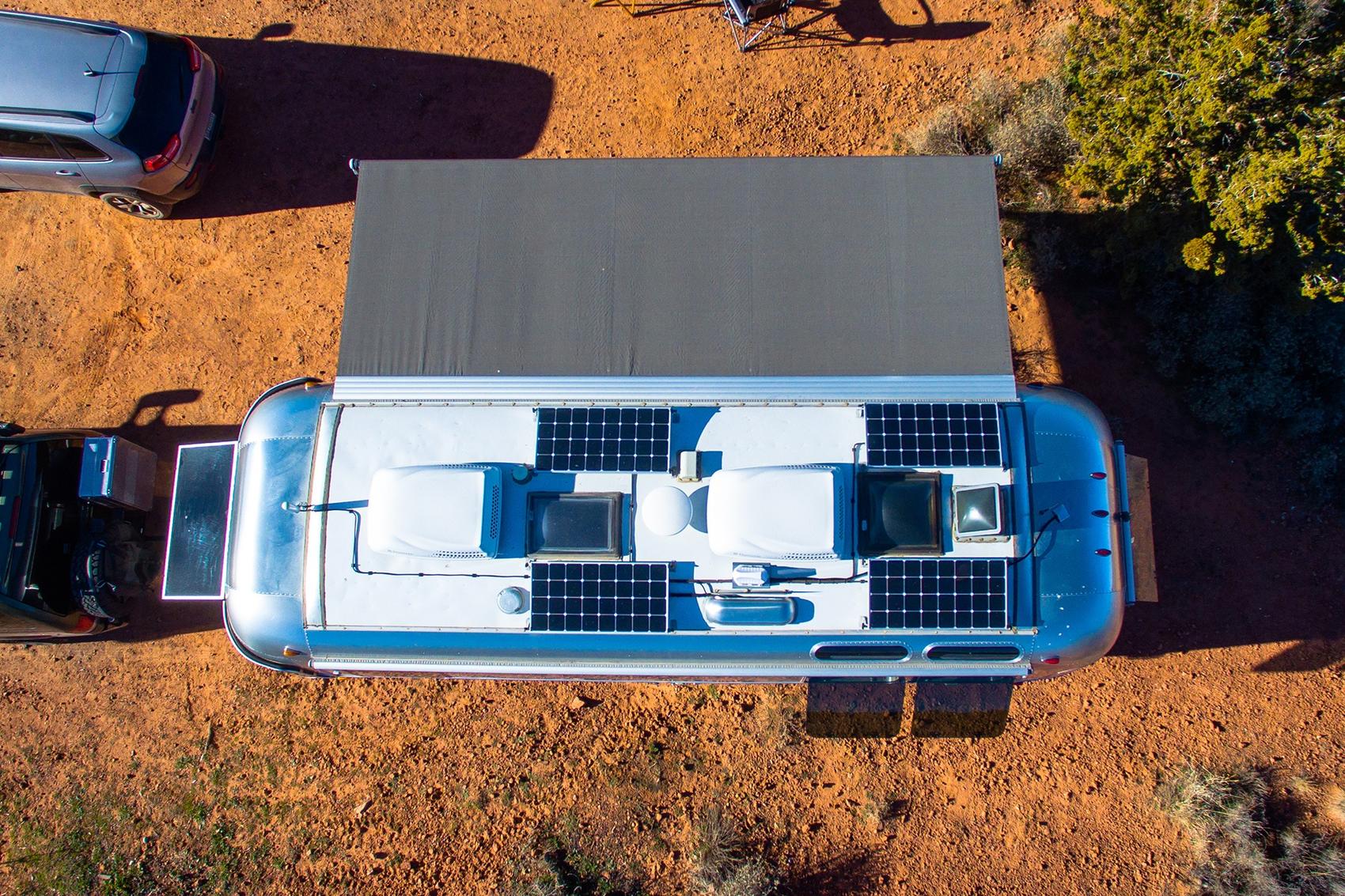
A typical travel trailer roof is around 6 by 20 feet, but the air conditioner, vents, antenna, and skylights eat most of it. After accounting for roof furniture, roughly 50 to 60 square feet of usable space remains, fitting about 6 standard modules, per published RV solar layout data.
In practice, travel trailers fit 400 to 1200W depending on trailer length and roof configuration. Small trailers manage 2 to 3 hundred-watt panels (each about 48 by 20 inches) without shading conflicts; longer trailers with clear roof runs can take 600W or more. Walk the roof with a tape measure before buying anything, and note where the AC shadow falls in the afternoon. For the hardware that holds them down, see our solar mounting guide.
Weight: the trailer constraint
Motorhomes shrug at an extra hundred pounds; travel trailers feel it in payload and tongue weight. Rigid residential-style panels weigh 55 to 70 pounds each, and a lithium battery bank adds 60 or more pounds, often placed in the front tongue box where it counts directly against tongue weight.
Check your trailer's GVWR and the tow vehicle's payload before committing to a big array. Lightweight options exist: Renogy's compact 100W suitcase is under 9 pounds, and flexible panels cut weight further at the cost of efficiency and lifespan. Roof work safety applies here too: use a spotter on the ladder and soft-soled shoes on the membrane.
Portable vs roof-mounted: the trailer decision
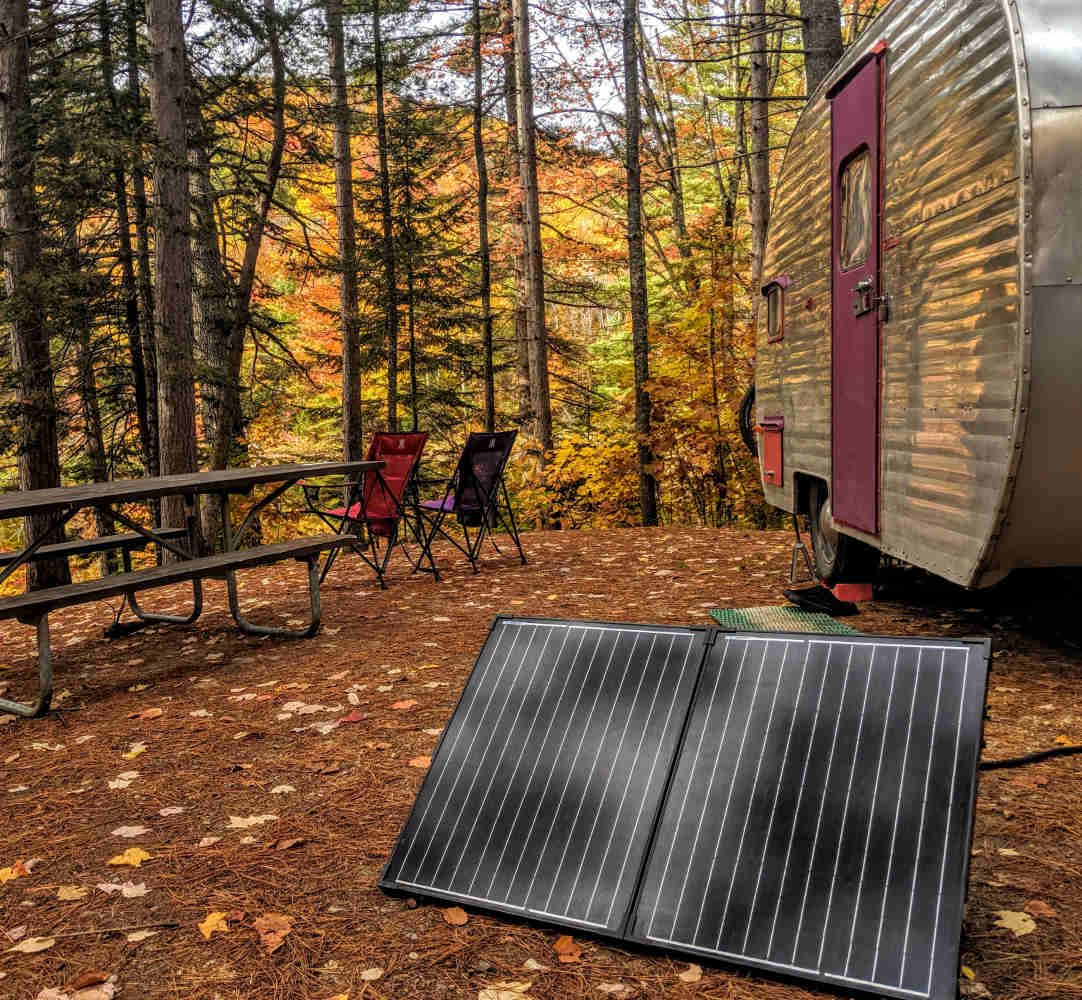
This is the defining trailer question, and the honest answer is that each wins in different campsites:
- Roof-mounted wins for full-timers and set-and-forget campers: it charges while you drive, needs no storage space, and cannot be stolen off the picnic table. The downside: at a wooded campsite your roof sits in shade while the sun shines twenty feet away.
- Portable suitcase wins at forested or shaded sites: you place the panel where the sun is and aim it through the day. Published suitcase specs: Renogy's standard 100W suitcase is 21.2 pounds folded; their compact N-type 100W is only 8.86 pounds; Zamp's 120W portable is 33 pounds with its own controller. The downsides: setup effort at every stop, storage space inside a small trailer, and theft risk.
Many experienced trailer owners eventually run both: a modest roof array for baseline charging plus a suitcase for shade-chasing. Run a long cable so the portable can sit well clear of the trailer's shadow.
Furrion and Zamp solar-ready ports explained
Many newer trailers wear a "solar ready" sticker by the tongue or side wall. Here is what that actually means: a pre-wired port connected straight to the house batteries. It is just wire and a fuse. No charge controller is included.
- Furrion port: proprietary 2-pin connector. Forest River's official flyer confirms a 10A fuse and 10 to 12 AWG cable, which means roughly 120W maximum through the port. The panel you plug in must have its own charge controller (many suitcase kits include one; verify before buying), or add one inline. Third-party MC4 panels need an MC4-to-Furrion adapter.
- Zamp port: SAE-style 2-pin, but Zamp reverses the polarity versus standard SAE connectors. A standard-polarity panel will read backwards and not charge. Always verify with a multimeter before connecting a non-Zamp panel, and use a polarity-correcting adapter if needed. Airstream's port is limited to 200W input.
The ports are convenient for suitcase panels but useless for roof arrays: roof panels get their own roof gland and wiring run, covered in our wiring diagram guide.
Battery + inverter pairing for trailers
The working rule from published trailer builds: 100Ah of battery pairs with about 300W of panels, so 200 to 250Ah pairs with 600W. Lithium dominates new installs for its usable capacity and weight savings; many owners mount the bank in the front tongue box to shorten cable runs.
A 2000W pure sine wave inverter runs everything in a typical trailer except the air conditioner, a combination documented in real owner builds (490W of panels, two 6V batteries, Xantrex Freedom XC 2000). Step to 3000W if you want microwave-plus-everything headroom. Battery chemistry detail lives in our RV battery system guide. If unsure about inverter wiring, consult a certified RV technician.
Charging while you drive
Many new trailer owners assume the 7-pin connector charges their batteries en route. It barely maintains them: the charge line is thin wire with heavy voltage drop over the trailer's length, so a depleted bank arrives still depleted.
The real upgrade is a DC-DC charger, such as the Renogy DCC50S used in documented trailer builds. It takes alternator power and boosts it to a proper multi-stage charge profile, making the drive leg a genuine third charging source alongside solar and shore power. Size it to your alternator and battery bank; 20 to 40A units suit most trailers.
Winter and storage
Trailers spend months in storage lots, and a small panel is the cheapest battery insurance there is: even 50 to 100W keeps batteries floated through winter. If the trailer sits under snow, roof panels produce nothing until cleared, which is fine for storage as long as the batteries were full going in.
Winter camping flips the load picture: the furnace blower becomes the dominant draw, panels produce less in short cold days, and LiFePO4 batteries must not charge below freezing unless heated. Size winter systems for the furnace first.
Three sample trailer builds
Small trailer, weekends: 100W suitcase panel with built-in controller plugged into the solar-ready port, 100Ah battery. Runs lights, pump, fan, phones, and a 12V fridge in summer. No roof holes, no inverter.
Midsize trailer, boondocking weeks: 400W roof array (4x100W), 40A MPPT controller, 200Ah lithium in the tongue box, 2000W inverter. Runs everything but AC; furnace through shoulder-season nights.
Full-time trailer: 800W roof (documented builds use 4x200W), 60A MPPT controller, 400Ah+ LiFePO4, 3000W inverter/charger, DC-DC charger for towing days. Genuine off-grid living except sustained air conditioning.
Frequently asked questions
How many watts of solar do I need for my travel trailer?
For weekend basics (lights, fan, pump, phone charging), 200 to 400W is enough. Comfortable boondocking with a 12V fridge and TV needs about 400W. Full-timing runs 600 to 1200W. Travel trailer roofs typically fit 400 to 1200W depending on trailer size and roof layout.
Can I run my RV air conditioner on solar?
A 13,500 BTU RV air conditioner draws 1300 to 1500W running and 2500 to 3500W on startup. Running it on solar requires 1000W or more of panels, 400Ah or more of lithium batteries, and a 3000W or larger inverter. For most trailer owners, AC stays a generator or shore-power job.
Roof-mounted or portable solar panels for a travel trailer?
Roof-mounted wins for full-timers and anyone who wants power without setup: it charges while you drive and needs no storage space. Portable suitcase panels win at wooded campsites where the roof sits in shade, since you can place the panel in the sun, and they need no roof holes. Many trailer owners eventually run both.
What does 'solar ready' mean on a travel trailer?
It means the trailer has a pre-wired solar port (Furrion or Zamp style) connected to the batteries. It is just wire and a fuse, there is no charge controller included. You still need a charge controller between the panel and the port, and the port's fuse limits how much panel you can plug in.
How many watts can I plug into the Furrion solar port?
About 120W. Forest River's official solar port flyer confirms a 10A fuse and 10 to 12 AWG cable, and 10A at 12V is roughly 120W. Exceeding the fuse rating blows it. Panels plugged into the port must have their own charge controller or one added inline.
Why won't my Zamp solar port work with a Renogy panel?
Zamp reverses the polarity of its SAE-style port versus the standard, so a standard-polarity panel reads backwards and will not charge. Check polarity with a multimeter before connecting any non-Zamp panel, and use a polarity-correcting adapter if needed.
Will 100W of solar run my 12V fridge in a travel trailer?
In good summer sun, yes. A 100W panel produces roughly 300 to 500Wh per day, and a 12V compressor fridge uses about 400 to 700Wh per day. The margin is thin on cloudy days, so 150 to 200W is the comfortable minimum if the fridge is your main load.
How much does it cost to add solar to a travel trailer?
A basic 200 to 400W portable or small roof setup runs about $800 to $2000. A midsize roof system with lithium batteries and an inverter runs $3000 to $8000. Factory-installed packages are generally cheaper than aftermarket installs of the same size.
Do I need an inverter with trailer solar?
Only if you want to run 120V AC appliances (TV, laptop chargers, microwave, coffee maker) off your batteries. Your trailer's lights, water pump, vent fans, and furnace blower all run natively on 12V and need no inverter. A 2000W inverter runs everything in a typical trailer except the air conditioner.
Does the 7-pin trailer plug charge my batteries while towing?
Barely. The 7-pin charge line is thin wire with significant voltage drop, so it maintains batteries at best and cannot recharge a depleted bank during a normal drive. A DC-DC charger (such as the Renogy DCC50S used in many trailer builds) boosts alternator power properly and is the real upgrade for charging while towing.