How-To Guides
Van Solar Panels: The Complete Guide to Solar for Vans & Campervans (2026)
Rigid vs flexible compared · Curved-roof mounting methods · DC-DC charging · US Class B framing · October 2026
Van solar is not RV solar on a smaller roof. Van roofs are curved, short, and often need to stay stealthy; vans drive regularly, which makes alternator charging a second power pillar; and smart alternators changed the wiring rules. This guide covers it all: rigid versus flexible panels for curved roofs, mounting methods, van-specific sizing, DC-DC charging, and when a small generator earns its place. For the full sizing math, see our RV solar sizing guide.
Affiliate disclosure: RV Solar Power Guide is reader-supported. When you buy through links on this page, we may earn a commission at no extra cost to you. Our picks come from comparing verified specs and price. We don't accept payment for placement.
Typical size
200-400W solar for part-time van life, 400-600W for full-time, paired with 100-400Ah LiFePO4.
Curved roofs
Flexible panels (Renogy, BougeRV Yuma) bend to the curve; rigid panels go on rails or raised brackets.
Second pillar
DC-DC alternator charging (~480Wh per driving hour at 40A) carries vans through cloudy stretches.
Generator
A small inverter generator (e.g. Honda EU2200i) backs up solar for cloudy weeks and AC loads.
Van solar panels guide
Roof safety: use a spotter on the ladder and never stand on a panel. For wiring or structural work you are unsure about, consult a certified RV technician or qualified installer.
Van life solar: what a van system looks like
A van life electrical system stands on three pillars: solar, alternator charging, and the battery bank between them. Vans cannot just copy RV setups: the roof is smaller and curved, the van may need to look unmodified for stealth camping, and modern smart alternators vary voltage in ways that break the old simple-relay charging trick. Design for all three pillars from the start.
Solar panels for vans: how van roofs differ
A Sprinter 144" wheelbase high roof offers roughly 139" of usable roof length and about 54" of width between the rail mount points (per published van-build engineering data); the 170" wheelbase gives roughly 170-175". Typical van roof width is about 5.75 ft, which is why 200W panels around 27-28" wide fit two across.
The roof is crowned with longitudinal ribs and the edges curve away, so the usable area is smaller than the footprint suggests. Practical capacity on a 144" Sprinter with one roof fan: 400-600W of rigid panels, or 600-800W of flexible (per the same engineering source). A 170" stretches that to 600-900W rigid or 800-1,200W flexible.
Rigid vs flexible panels for curved van roofs
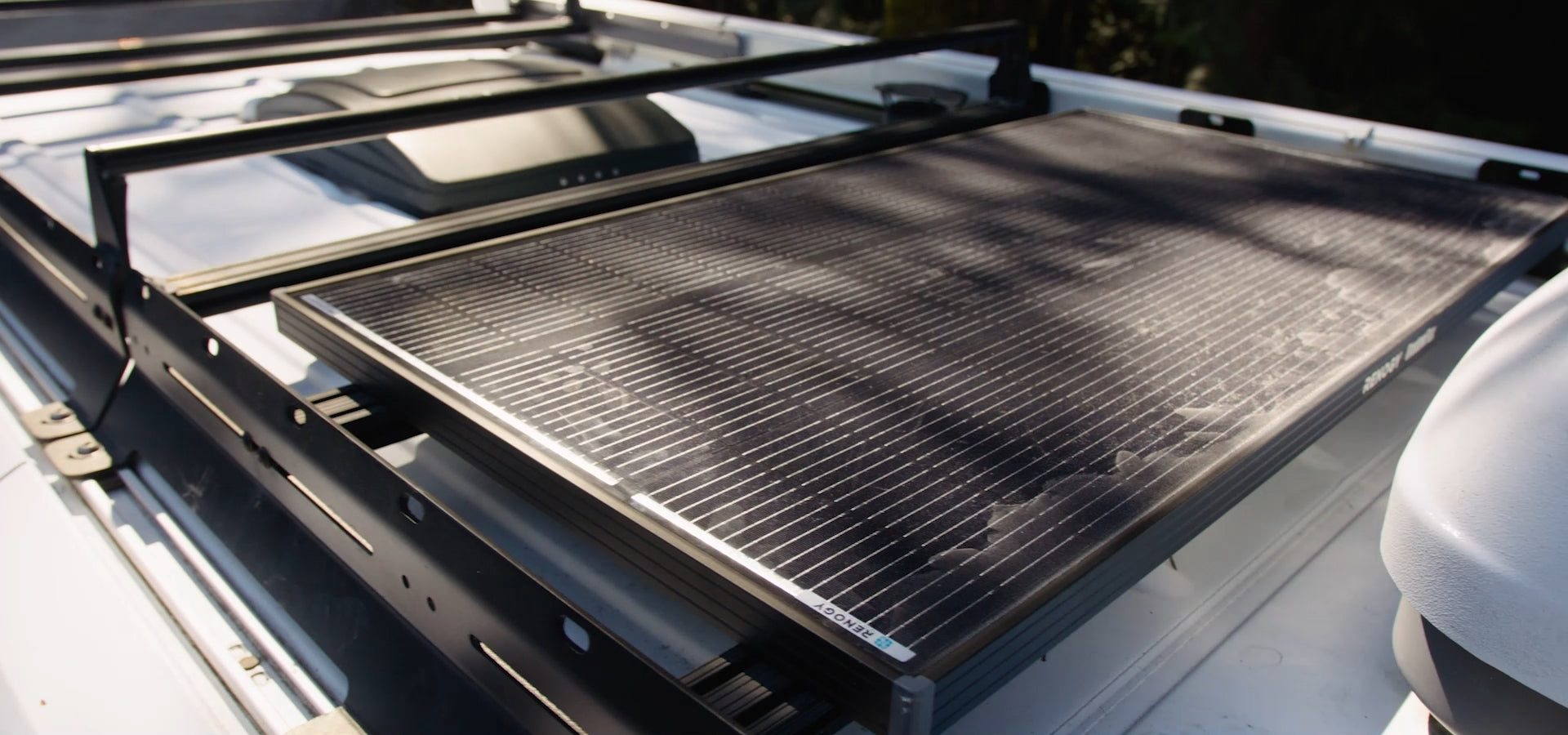
Rigid panels (e.g., Renogy 200W N-Type, Newpowa 200W) win on efficiency (~21-25%), long warranties, and cost per watt. They need rails or raised brackets and a reasonably flat mounting zone.
Flexible panels own the curved-roof niche:
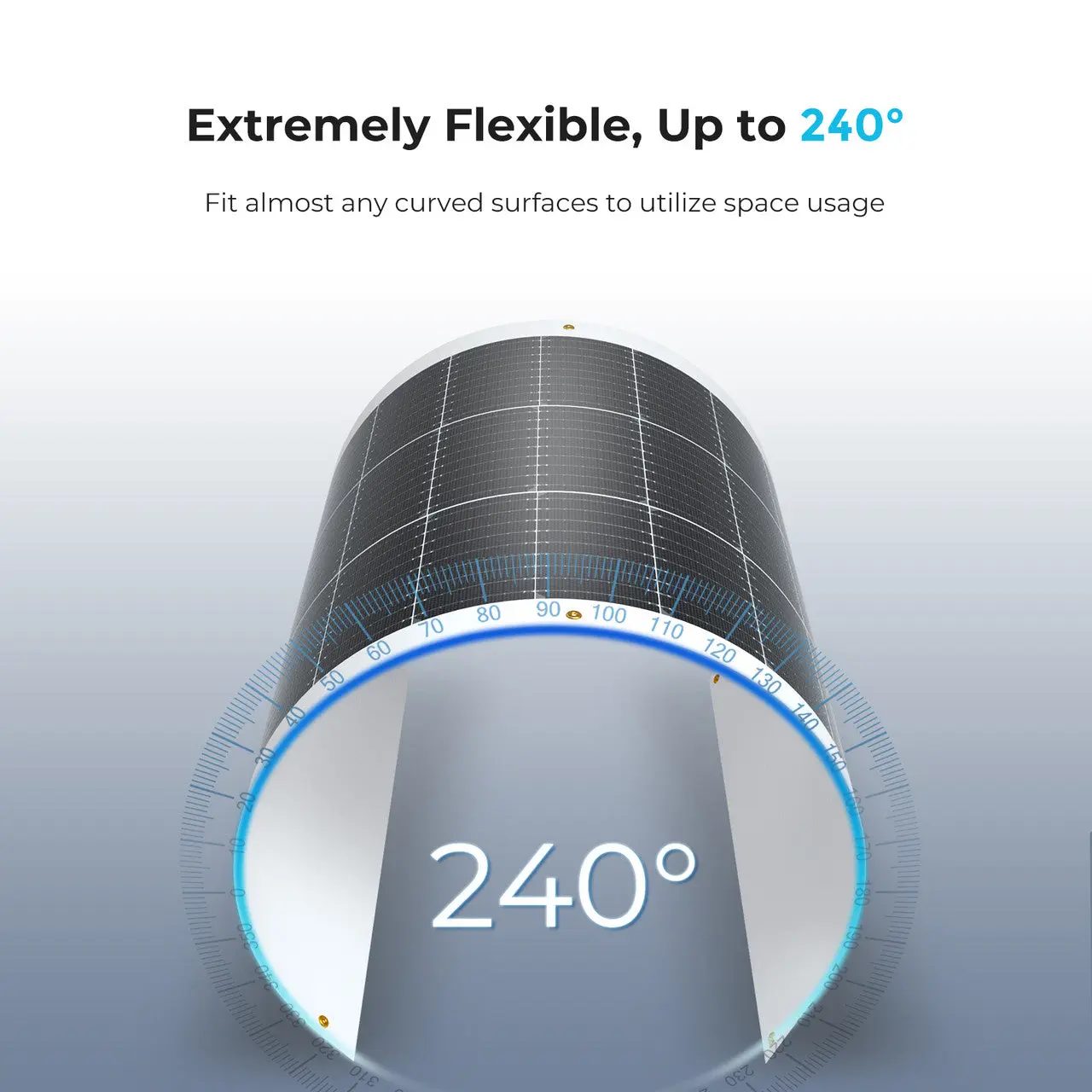
- Renogy flexible (50/100/175/200W): bendable up to 240-248 degrees; the 100W weighs 4.2 lbs and the 175W weighs 6.2 lbs, about 70% less than rigid equivalents. IP68 junction box. For mobile use, Renogy specifies silicone structural adhesive mounting (grommets are for non-mobile installs).
- BougeRV Yuma CIGS thin-film (100/200W): 360-degree flexible, 4.3 lbs (100W) and 6.39 lbs (200W), IP68 with ETFE coating, 16% cell efficiency, 25-year design life. Self-adhesive or pre-drilled versions.
- Goal Zero Flex 100i: flexible monocrystalline that mounts on flat and curved surfaces, IP67 waterproof.
Honest trade-offs: flexible panels run hotter bonded flat to the roof (no airflow gap, unlike rigid on brackets); their material warranties are shorter (typically 5 years workmanship versus 25-year power warranties on rigid); and efficiency runs lower (the Yuma's 16% versus ~21-25% for rigid mono). Choose rigid on rails for maximum power, flexible for curves, stealth, and weight.
Mounting solar panels on a curved van roof
- Roof rails/channels: vans with factory roof channels accept sliding fixings or rail mounts; rigid panels on rails keep the cooling airflow gap.
- Z-brackets: keep backspacing under the panel for passive cooling; workable on curved roofs with careful placement.
- VHB tape: works for lightweight panels on new urethane paint, but the bond is only as strong as the paint underneath. Engineering analysis notes VHB is extraordinary in shear and unforgiving in tension: at highway wind speeds, when it lets go it lets go completely. Screwing or bolting brackets through the roof is the belt-and-suspenders answer.
- Flexible-panel adhesive: BougeRV Yuma ships self-adhesive backed for direct sticking to curved surfaces; Renogy requires silicone structural adhesive for mobile applications.
- Wind noise: the air gap under rigid panels costs efficiency less but noise more; a fairing at the front panel edge cuts it.
- Cable entry: cable glands (right-angle if tight) with Dicor self-leveling sealant around the base; flexible-panel cables need zip-tie mounts on the roof since they cannot tuck underneath.
- Shadow discipline: lay out roof furniture (fan, vent, light bar, roof box) before buying panels. A shaded slice of a panel cuts output disproportionately.
Your van solar system: components at a glance
Panels feed an MPPT charge controller, which charges the battery bank, which feeds a 12V fuse box and (optionally) an inverter for 120V AC loads. For controller selection see our MPPT charge controller guide; for batteries see our RV battery system guide. The van's second pillar, alternator charging through a DC-DC charger, is covered next.
Campervan solar power: real build examples
- Weekend build: 200W solar + 100Ah LiFePO4. Lights, fan, phone and laptop charging, a 12V fridge in mild weather.
- Full-time build: 400-600W solar + 200Ah LiFePO4 + 30-50A DC-DC charger. The published benchmark for most full-time van builds: 200-400W solar plus a DC-DC charger covers typical loads with margin.
- High-end build: 600W+ solar (e.g., three 200W panels) + 300-400Ah LiFePO4 + a Victron stack. One documented Sprinter 170 build runs a Victron Orion DC-DC 30A with 600W of solar and triple 100Ah batteries.
Alternator charging: the DC-DC charger
Why not just a relay between the starter and house batteries? Two reasons: modern smart alternators vary voltage (roughly 12-16V) for fuel economy, and standard alternator output (13.8-14.4V) cannot fully charge lithium batteries. A DC-DC charger takes whatever the alternator gives and outputs a proper multi-stage charge, while protecting the starter battery from drain.
- Renogy DCC50S: 50A max (25A solar + 25A alternator simultaneously), 660W max solar input, works with traditional and smart alternators, lithium/AGM/flooded profiles.
- Victron Orion-Tr Smart 12/12-30A: smart-alternator and lithium safe, Bluetooth configuration.
- Rule of thumb: a 40A DC-DC charger adds roughly 480Wh per driving hour. One Ford Transit owner reports a 50A unit recovering about 90% of the battery on highway trips.
Van generator: the solar complement
Solar plus alternator charging covers typical 12V life. The generator's job is the two things solar cannot do: multi-day cloudy stretches and high-draw AC loads (microwave, small AC). It charges batteries through your converter/charger.
The reference unit is the Honda EU2200i: 2,200W peak / 1,800W running, 48-57 dB(A) (quieter than normal conversation), 47.4 lbs, 0.95-gallon tank, up to 8.1 hours runtime, parallel-capable (two units = 4,400W), CO-MINDER auto shutoff, and clean sub-3% THD power for electronics.
Placement rules mirror our generator mount guide: never inside or under the van, exhaust away from doors, windows, and vents, and a working CO detector inside the van.
Stealth, weight, and aerodynamics
- Stealth: flexible panels sit nearly flush and read as part of the roof; rigid panels on raised brackets announce the build. Stealth campers trade some efficiency for invisibility.
- Weight: flexible panels run about 70% lighter than rigid equivalents, which matters on a van's limited roof and payload budget.
- Aerodynamics: raised rigid panels add drag and noise; keep the profile low and add a front fairing.
- Roof-load common sense: spread mounts across structural points, not just sheet metal, and retorque after the first long drive.
Frequently asked questions
How many watts of solar do I need for van life?
Most van lifers land at 200 to 400W for weekend or part-time use, and 400 to 600W for full-time living. Pair it with roughly 100 to 200Ah of LiFePO4 storage per 200W of solar as a starting point. For the full sizing math, see our RV solar sizing guide.
Can you put solar panels on a curved van roof?
Yes. Flexible panels bend to follow the curve: Renogy's flexible line bends up to about 248 degrees, and BougeRV's Yuma CIGS thin-film panels flex a full 360 degrees. Flexible panels mount with structural silicone adhesive or VHB tape; rigid panels go on roof rails or raised brackets.
Rigid vs flexible solar panels for a van: which is better?
Rigid wins on power, efficiency, and warranty; flexible wins on curved roofs, stealth, and weight (about 70% lighter). Honest trade-offs: flexible panels run hotter bonded flat with no airflow gap, carry shorter material warranties, and give slightly lower efficiency. Choose rigid on rails for max power, flexible for curves and low profile.
How do you mount solar panels on a Sprinter van?
Three proven ways: rigid panels on the factory roof rails or channels with sliding fixings, Z-brackets that keep an airflow gap under the panel, or VHB tape for lightweight panels on new urethane paint. Flexible panels mount with silicone structural adhesive per the maker's mobile-use instructions.
Do I need a DC-DC charger if I have solar?
Strongly recommended for any van that drives regularly. Solar alone struggles in winter and the Pacific Northwest, and modern smart alternators vary voltage in ways a simple relay cannot handle. A 40A DC-DC charger adds roughly 480Wh per driving hour, which can carry a build through a cloudy week.
How much battery do I need with 400W of van solar?
About 200Ah of LiFePO4 is the typical pairing for 400W of van solar: enough to bank a good solar day and ride out an overcast one. See our RV battery system guide for battery types and sizing in depth.
Will flexible solar panels overheat on a van roof?
They run hotter than rigid panels on raised brackets, because bonding flat to the roof removes the airflow gap. Heat costs some output on hot days. If maximum summer performance matters and your roof allows it, rigid panels on rails with an air gap stay cooler.
Can I run AC off van solar panels?
Usually not from solar and battery alone: a small AC draws 500 to 1,000W+ continuously, which outruns any realistic van roof in real heat. A portable inverter generator (like the Honda EU2200i at 1,800 running watts) is the practical answer for AC loads.
Do I need a generator if I have van solar?
Not for typical 12V loads, but a small inverter generator is the standard backup for multi-day cloudy stretches and high-draw AC appliances. It charges batteries through your converter/charger. See the van generator section of this guide.
What is the best solar panel for a campervan?
It depends on your roof: rigid 200W panels (Renogy N-Type, Newpowa) on rails for maximum power on flatter roofs; Renogy flexible or BougeRV Yuma CIGS thin-film for curved roofs and stealth builds. Match the panel to the roof first, then to your wattage target.